

Source numbers link to evidence. [Inference] marks analytical judgment, including motion classifications and causal explanations. Public evidence does not establish every internal decision or metric.
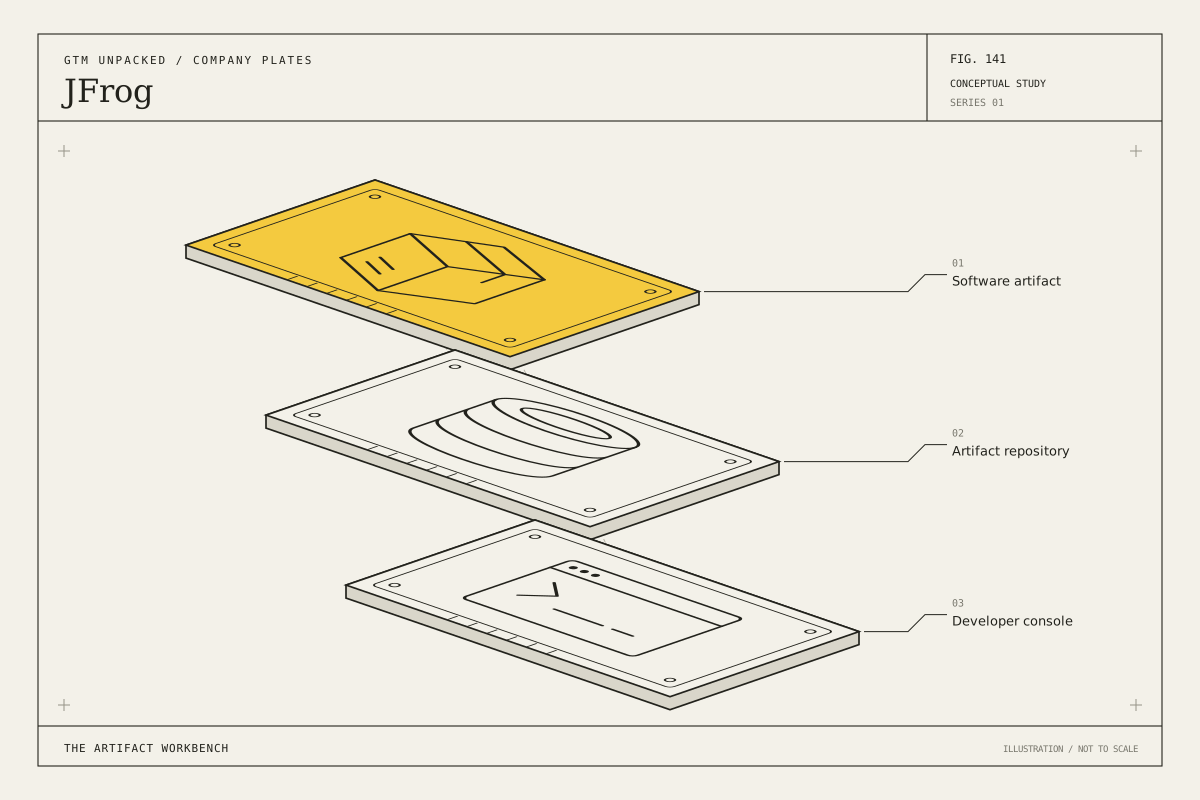
Conceptual illustration for JFrog: a package, a database, and a terminal evoke software artifacts organized beside their developer tools, without representing verified technical architecture.
- Company
- JFrog · Developer tools and communities · jfrog.com
- Conversion motions
- [Inference] This research classifies JFrog as Product Led, Human Led and Partner Led.
- JFrog beachhead
- Developers managing software packages and binary artifacts. [1]
- JFrog target customer
- DevOps, platform engineering and software-supply-chain security teams. [4]
- Product complexity
- [Inference] Repository adoption is bounded; multisite governance and security are complex. [4]
- Decision-making unit
- [Inference] Engineers can champion adoption; enterprise reliability and security broaden approval. [4]
- Market at entry
- Artifactory began as an open-source package-management project before the company formed in 2008. [1]
- Market today
- Current packaging spans artifact management, security, governance and AI assets. [4]
- Evidence
- Source-backed brief · 4 linked sources · research date · method and limitations
The ten-step Revenue Engine reading map
These links locate relevant evidence. A linked section does not imply every detail of the step is publicly established.
- Acquire Your First Customers: Founder Led Sales Read first customers
- Embrace GTM Experimentation Read experiments & lessons
- Understand Your GTM Motion Options Read GTM motion
- Pick Your GTM Motion Not established in this entry
- Generate a Lead Read GTM motion · Read experiments & lessons
- Turn Leads into Paying Customers Read GTM motion · Read people & process
- Retain and Grow Your Customers Read retain & expand
- Build Your GTM Team Read people & process
- Plan Your Tech Stack Read experiments & lessons · Read people & process
- Optimize and Scale Through Metrics Read pricing & economics
JFrog origin and first customers: Open-source adoption became a customer relationship
JFrog’s own history says the company formed in 2008 around the open-source Artifactory project. It identifies early enthusiasm among developers as the foundation for commercialization. An IDC report hosted by JFrog names Shlomi Ben Haim, Yoav Landman and Fred Simon as founders. [1][3]
Ben Haim’s 2020 tribute names Carl Quinn as a first customer and specifically the first to use Artifactory as an Ivy repository at Netflix in 2009. Quinn later worked at Riot Games and Zoox. Ben Haim credits his feedback with influencing Docker-registry and universal-repository development. This documents a real champion and product-learning relationship; the original sale amount is not disclosed. [2]
[1] [2] [3]JFrog GTM motion: From a useful repository to a negotiated platform
[Inference] Open-source access let technical users verify utility before the company asked for a larger commitment. The paid boundary then moved toward reliability, scale and organizational control. A repository is well positioned to expand because it sits in a repeated software-release workflow, but embedded use should not be confused with an independently measured retention rate. [1][4]
The live pricing page offers direct purchase, cloud marketplace purchase and contact-sales paths. Monthly SaaS customers can upgrade from Pro to Enterprise X themselves; annual agreements and customized packages involve the account team. This makes the motion visibly hybrid rather than exclusively sales led or exclusively self-service. [4]
[1] [4]JFrog retention and expansion: Technical support is part of the commercial ladder
JFrog describes community support for free and entry plans, contractual response coverage for Enterprise X, and an assigned technical account lead for Enterprise+. The latter assists adoption and best practices; higher support packages include roadmap and account-team interaction. These are current offer descriptions, not evidence of when each service first appeared. [4]
[Inference] The expansion conversation can follow an operational threshold: more sites, stricter availability requirements or a need for consistent security policy. Technical account management can help the buyer realize those outcomes and discover adjacent needs. It should not be reduced to pressuring an already dependent customer to buy features unrelated to its risk. [4]
[4]JFrog people and process: The customer who carried the story
Quinn participated in community events and was selected for the planned SuperFrogs advocacy program. He was not a JFrog employee. Treating him as an internal account executive would erase the distinctive mechanism: an external practitioner advising the product and advocating among peers. [2]
[Inference] Customer advocacy is most credible when it rests on substantial product use and useful feedback. The lesson is to cultivate expert relationships, not to assume that branded community programs create advocacy on demand. Named early sales and success hires, compensation and training were not established in this brief. [2]
[2]JFrog pricing and economics: A more complex pricing surface than a simple seat fee
Current packaging separates SaaS from self-managed deployments, combines subscription and consumption, and offers custom enterprise arrangements. The page also carries time-limited promotions, so promotional amounts should not be treated as durable price history. Storage/transfer consumption and security-related developer measures make unlike plans difficult to compare directly. [4]
[Inference] Expansion has several dimensions—usage, deployment footprint and product scope. That can align pricing with customer scale, but makes budgeting and value attribution harder. A good sales process should show the marginal cost and benefit of each expansion. No verified CAC, segment margin or renewal cohort was retrieved. [4]
[4]JFrog experiments and lessons: Why the strategy worked and where it can strain
[Inference] The strongest mechanism is product credibility reinforced by an expert champion, followed by operational features organizations need at scale. The broad modern platform can also obscure the original easy-to-understand job. Clear entry use cases and transparent migration guidance would reduce that risk. No specific failed early acquisition campaign was verified. [1][2][4]
[1] [2] [4]JFrog economics at a glance: Pricing is only half the story.
Subscription plus consumption, separate SaaS/self-managed offers and custom enterprise arrangements. [4]
See the dated pricing analysis.
[Inference] The relevant costs and conversion frictions are discussed in the analysis; no invented margin model is supplied.
Not verified in this brief.
No cohort retention figure verified in this brief.
The people in the JFrog GTM story: People & capabilities.
Shlomi Ben Haim
CofounderNamed in the company-hosted IDC profile; detailed prior training not verified.
Maintained the documented relationship with early customer Carl Quinn. [2][3]
[2] [3]Yoav Landman and Fred Simon
CofoundersIdentified in the IDC profile; detailed biographies not researched in this brief.
Part of the founding team commercializing Artifactory. [3]
[3]Carl Quinn
Early customer and advocateWorked at Netflix, later Riot Games and Zoox.
Influenced product development and peer advocacy; never a JFrog employee. [2]
[2]JFrog GTM: critical reading and analysis: Why it worked.
Where it breaks.
What worked—and why
[Inference] Expert customer feedback and advocacy supported platform expansion. [2]
What did not work
No verified failed early channel in inspected sources.
What could have been better
[Inference] Make marginal consumption and platform upgrades easy to understand.
What another founder can use
[Inference] A trusted developer champion helped turn one repository into a platform.
JFrog go-to-market FAQ: The questions that matter.
How did JFrog find its GTM motion?
A trusted developer champion helped turn one repository into a platform. See the sourced account and explicitly labeled analysis above.
JFrog sources and open questions: Follow the sources.
- Downloads & Open Source Solutions JFrog · primary
Inspected for the facts attributed in this brief; current pages observed November 10, 2026.
- In Memory of a SuperFrog, Carl Quinn JFrog · primary · 2020-04-03
Inspected for the facts attributed in this brief; current pages observed November 10, 2026.
- IDC Innovators: DevOps Code Release Management IDC via JFrog · reporting
July 2018 report inspected for founder identification; an exact publication day was not verified.
- Platform Pricing & Plans JFrog · primary
Inspected for the facts attributed in this brief; current pages observed November 10, 2026.
What remains unverified
Named early sales and customer-success hires, training, compensation and individual account assignments remain incompletely documented.
No verified CAC, payback, funnel conversion or numerical retention series in this brief.
Historical website/pricing screenshots were not captured for this company; dated textual evidence is distinguished from current pages.
No verified visual capture is attached to this entry. A current screenshot is not a substitute for a historical capture.


