
Source numbers link to evidence. [Inference] marks analytical judgment, including motion classifications and causal explanations. Public evidence does not establish every internal decision or metric.
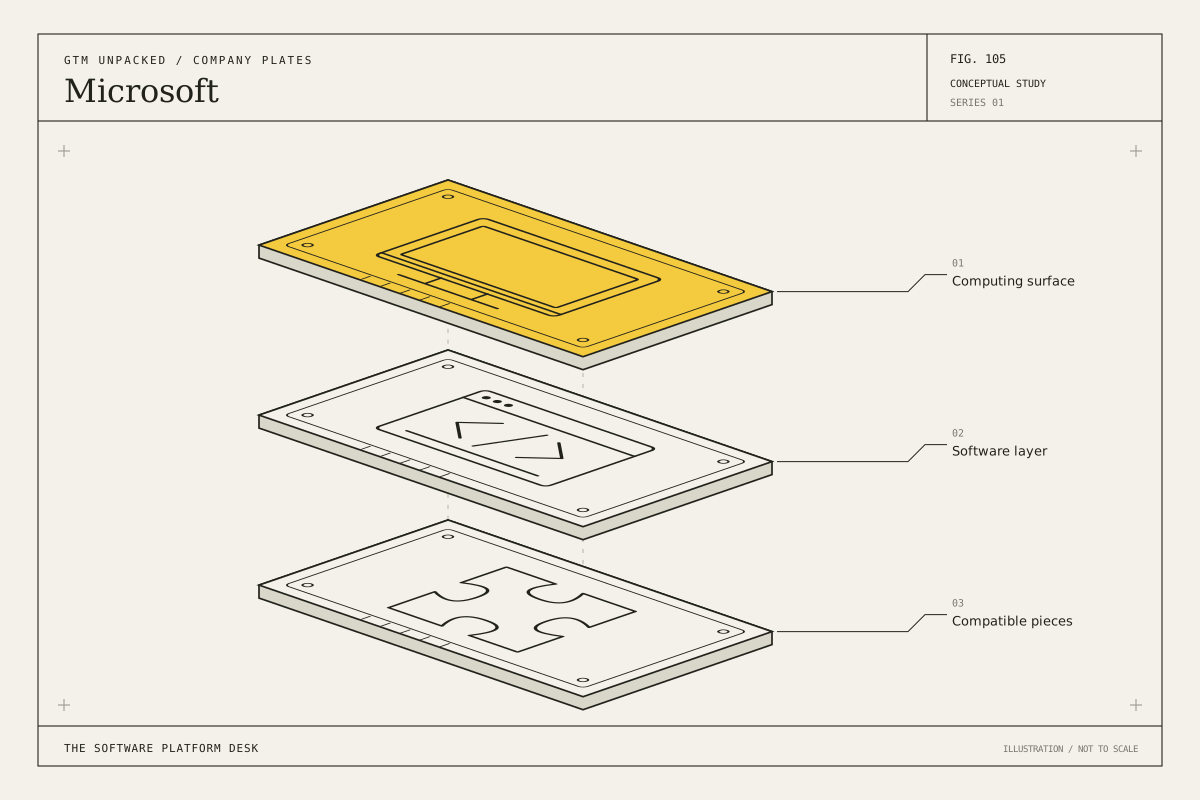
Conceptual illustration for Microsoft: a monitor, code brackets, and puzzle pieces evoke software platforms and complementary tools sharing a workspace, without representing verified technical architecture.
- Company
- Microsoft · Software platforms · microsoft.com
- Conversion motions
- [Inference] This research classifies Microsoft as Partner Led, Human Led and Product Led.
- Microsoft beachhead
- Programming language for the Altair microcomputer
- Microsoft target customer
- Consumers, developers and enterprises across productivity and infrastructure
- Product complexity
- Varies from individual apps to highly integrated infrastructure
- Decision-making unit
- [Inference] Simple consumer purchase; complex enterprise platform decision
- Market at entry
- Personal computing was an emerging market without established software distribution
- Market today
- [Inference] Mature platforms with cloud and AI workloads creating new expansion demands
- Evidence
- Source-backed brief · 6 linked sources · research date · method and limitations
The ten-step Revenue Engine reading map
These links locate relevant evidence. A linked section does not imply every detail of the step is publicly established.
- Acquire Your First Customers: Founder Led Sales Read first customers
- Embrace GTM Experimentation Read experiments & lessons
- Understand Your GTM Motion Options Read GTM motion
- Pick Your GTM Motion Read beachhead & buyer · Read product & market
- Generate a Lead Read GTM motion · Read experiments & lessons
- Turn Leads into Paying Customers Read GTM motion · Read people & process
- Retain and Grow Your Customers Read retain & expand
- Build Your GTM Team Read people & process
- Plan Your Tech Stack Read experiments & lessons · Read people & process · Read product & pricing archive
- Optimize and Scale Through Metrics Read pricing & economics
Microsoft origin and first customers: Origin & first customers
Bill Gates’ retrospective gives a concrete founder-sales sequence: Paul Allen wrote to MITS claiming they had BASIC for its Altair, then they followed up by telephone. MITS president Ed Roberts offered the deal to whoever produced a working version first. Allen demonstrated the software in Albuquerque after the founders built it without access to an actual Altair. [1] This is a founder-led technical proof, followed by distribution through a hardware company.
[1]Microsoft beachhead and buyer: Beachhead & buyer
Microsoft’s official history identifies MITS as its first customer in 1975 and records that year’s sales at $16,005. [2] [Inference] The beachhead was narrow and urgent: a machine needed a usable programming language. A contract with its maker reached end users more efficiently than inventing a consumer software channel from scratch. The demonstration mattered because it converted a claim into evidence that the hardware could do useful work.
[2]Microsoft GTM motion: GTM motion & lead conversion
The official 1981 timeline records IBM launching its PC with MS-DOS and other Microsoft language products. [3] [Inference] OEM distribution can combine one difficult commercial negotiation with many downstream installations. The relevant lesson is a partner’s incentive to sell a complete solution, not simply borrowing a large company’s logo. It also concentrates risk if the partner controls access, terms or the user relationship.
[3]Microsoft product and market: Product, market & buying complexity
[Inference] Microsoft’s current breadth should not be projected backward into 1975. A language interpreter for one new computer, an operating-system standard and a modern enterprise cloud suite solve different buying problems. In large organizations, software interoperability, security, migration and user behavior create a complex decision unit. Winning the initial license is only one stage; deploying it successfully is necessary before meaningful expansion can follow.
Microsoft people and process: People & operating process
Microsoft identifies Steve Ballmer as its first business manager, hired in 1980, and credits him with helping land the IBM agreement. A company-hosted 2006 biography records Harvard mathematics and economics training and Stanford business-school attendance, along with responsibility for sales and operations. [4][6] [Inference] The transition from founders making technical promises to a management system required commercial and organizational capacity alongside engineering.
[4] [6]Microsoft retention and expansion: Customer success & expansion
Today’s FastTrack documentation describes deployment and adoption assistance for eligible subscriptions, with success planning, onboarding and partner involvement. Microsoft 365 guidance generally specifies at least 150 eligible licenses, with separate conditions for migration benefits. [5] [Inference] Enablement helps turn a portfolio contract into utilized capabilities. Partners add delivery capacity and retain a role in the customer relationship, which can support subsequent workload adoption.
[5]Microsoft pricing and economics: Pricing & economic constraints
[Inference] OEM royalties, enterprise subscriptions and cloud consumption have materially different economics. A high-margin software license does not reveal the cost of cloud infrastructure or specialist deployment support. This brief therefore does not combine them into a synthetic CAC or LTV estimate. The original $16,005 sales figure is historical revenue, not a benchmark for the present model. Pricing and contribution margin need to be measured at the product and segment level. [2]
[2]Microsoft experiments and lessons: Experiments, lessons & critique
[Inference] The strongest generalizable pattern is complementary distribution: make the partner’s product more useful, then invest in the capabilities that help customers adopt it. The failure risk is assuming bundled availability equals usage. A better account expansion process should measure activated workloads, real user adoption and business outcomes before treating every licensed seat as successful. This brief does not infer specific internal CRM tooling from Microsoft’s product catalog.
Microsoft website and pricing history: Positioning & pricing evolution
The inspected documents support the progression from the 1975 MITS sale to the 1981 IBM platform partnership and modern adoption services. [1][3][5] [Inference] This is a sequence of changing motions, rather than one timeless sales formula. A complete analysis of every Microsoft business would require separate cases. Historical website screenshots are absent because the earliest GTM history predates the public web and later captures were not verified.
[1] [3] [5]Microsoft economics at a glance: Pricing is only half the story.
Multiple product-specific pricing systems; not condensed to one price.
OEM licenses, subscriptions and cloud consumption
[Inference] Economics must separate software distribution from infrastructure and enterprise enablement costs.
Not publicly verified
Not publicly verified
The people in the Microsoft GTM story: People & capabilities.
Bill Gates
Co-founderDesigned and wrote the initial BASIC interpreter, according to his retrospective.
Combined technical delivery with founder-level customer outreach. [1]
[1]Paul Allen
Co-founderBuilt the Altair simulation and demonstrated BASIC to MITS.
Converted the initial prospect into a hardware-distribution agreement. [1]
[1]Steve Ballmer
First business manager, hired 1980Harvard mathematics/economics; Stanford business-school attendance.
Added sales and operating leadership and helped the IBM deal. [4]
[4] [6]Microsoft GTM: critical reading and analysis: Why it worked.
Where it breaks.
What worked—and why
[Inference] Hardware partners distributed software that increased machine usefulness. [1][3]
What did not work
No specific early failed channel was verified in these sources.
What could have been better
[Inference] Treat activation and usage as distinct from licensed capacity.
What another founder can use
[Inference] Partner-led growth works when both parties gain from completing the customer solution.
Microsoft go-to-market FAQ: The questions that matter.
How did Microsoft find its GTM motion?
The official 1981 timeline records IBM launching its PC with MS-DOS and other Microsoft language products. [3] [Inference] OEM distribution can combine one difficult commercial negotiation with many downstream installations. The relevant lesson is a partner’s incentive to sell a complete solution, not simply borrowing a large company’s logo. It also concentrates risk if the partner controls access, terms or the user relationship.
What can founders learn from Microsoft?
[Inference] Partner-led growth works when both parties gain from completing the customer solution.
Microsoft sources and open questions: Follow the sources.
- My time and career at Microsoft Bill Gates · interview
- History of Microsoft: 1975 Microsoft · primary
- History of Microsoft: 1981 Microsoft · primary
- Steve Ballmer named CEO Microsoft · primary
- FastTrack FAQs Microsoft · primary
- Steve Ballmer at Commonwealth Club Microsoft · primary · 2006-05-12
What remains unverified
No verified historical website screenshot was available for this brief.
Early CRM, sales engagement and enablement tools were not verified; product integrations are not treated as internal GTM tools.
Exact first paid contract and early funnel conversion are not publicly verified in the inspected sources.
No verified visual capture is attached to this entry. A current screenshot is not a substitute for a historical capture.