
Source numbers link to evidence. [Inference] marks analytical judgment, including motion classifications and causal explanations. Public evidence does not establish every internal decision or metric.
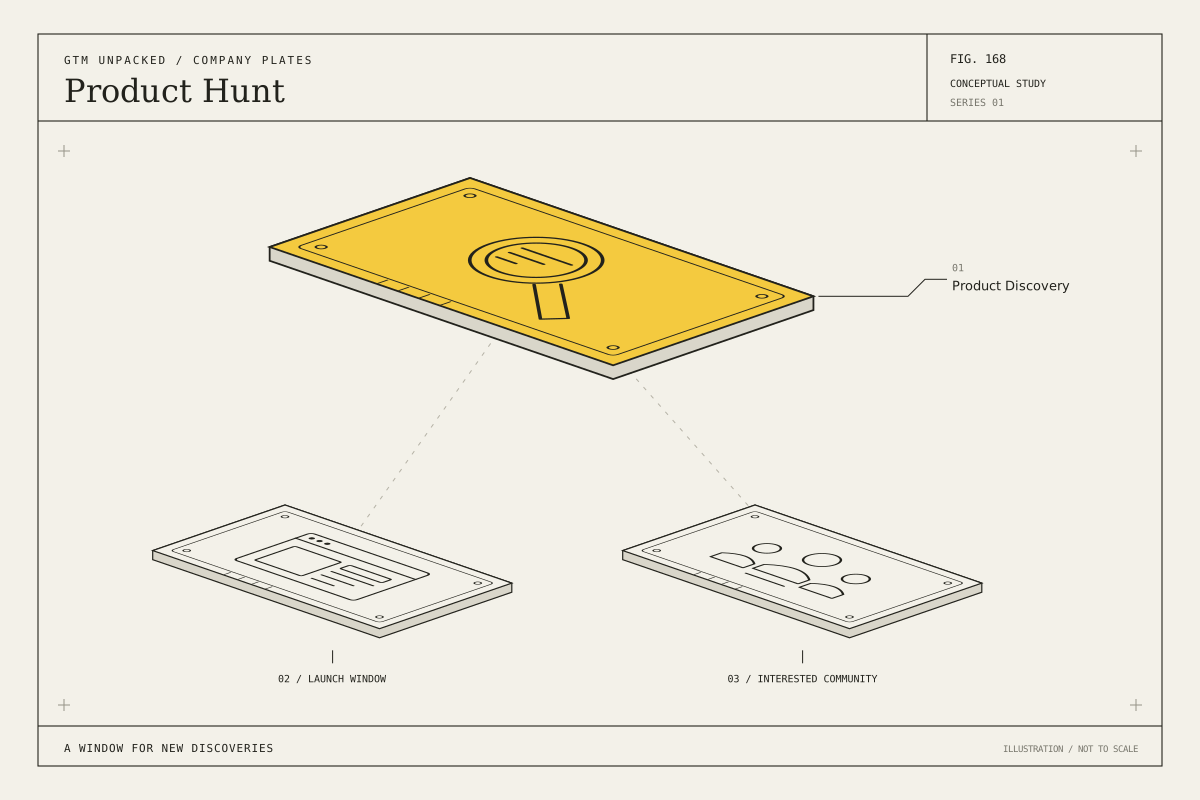
Conceptual illustration of product discovery through a browser window and search lens, with people forming a surrounding community of attention and curiosity.
- Company
- Product Hunt · Product discovery and communities · producthunt.com
- Conversion motions
- [Inference] This research classifies Product Hunt as Marketing Led and Product Led.
- Product Hunt beachhead
- Product enthusiasts, startup founders and investors sharing new software discoveries. [1]
- Product Hunt target customer
- Makers seeking discovery, people exploring products and advertisers buying relevant attention. [2]
- Product complexity
- [Inference] Submission and discovery are simple; maintaining credible curation and commercial incentives is harder.
- Decision-making unit
- [Inference] Individuals can participate; paid promotion adds a marketing budget decision.
- Market at entry
- The founder identified a recurring discovery conversation without a dedicated community home. [1]
- Market today
- The current platform separates free new launches from labeled paid promotion. [2]
- Evidence
- Source-backed brief · 2 linked sources · research date · method and limitations
The ten-step Revenue Engine reading map
These links locate relevant evidence. A linked section does not imply every detail of the step is publicly established.
- Acquire Your First Customers: Founder Led Sales Read first customers
- Embrace GTM Experimentation Not established in this entry
- Understand Your GTM Motion Options Read GTM motion
- Pick Your GTM Motion Not established in this entry
- Generate a Lead Read GTM motion
- Turn Leads into Paying Customers Read GTM motion · Read people & process
- Retain and Grow Your Customers Read retain & expand
- Build Your GTM Team Read people & process
- Plan Your Tech Stack Read people & process
- Optimize and Scale Through Metrics Read pricing & economics
Product Hunt origin and first customers: A twenty-minute test used an existing social network
Ryan Hoover’s December 2013 account describes creating a Linkydink email group, inviting startup friends and sharing it through his blog, Quibb and Twitter. Within two weeks he reported more than 170 subscribers and 30 selected contributors. Nathan Bashaw then helped build the first website. Hoover explicitly credits earlier writing and relationship-building; he did not begin with an empty audience. [1]
[Inference] The experiment tested whether people wanted to contribute and receive discoveries before testing a full software interface. The scarce input was a good group of participants, not custom code. A founder without that network would need a different plan to supply trustworthy initial contributions. [1]
[1]Product Hunt GTM motion: The founder sold participation, not enterprise licenses
Hoover describes gathering feedback from founding contributors and seeding the community before a broader press launch. The early outcome was participation and subscriber interest, not paid contracts. This distinction matters: the first users demonstrated a discovery habit, while monetization required a separate offer. [1]
[Inference] A community member can become both reader and contributor, so acquisition and product quality reinforce one another. But a launch spike is not automatically lasting engagement. The relevant early question is whether people repeatedly return for useful discoveries and discussion after the novelty of the site fades. [1]
[1]Product Hunt people and process: Editorial judgment and fast implementation complemented each other
Hoover brought writing, product interest and relationships with founders, investors and bloggers. Bashaw is described as a designer/developer friend who could turn the idea into a working website. Their complementary contribution was curation plus implementation, rather than a large paid-acquisition operation. The source does not document formal sales training or a first account executive. [1]
[Inference] The founder’s personal taste helped establish a recognizable starting standard. As participation scales, that standard must become an understandable product and moderation process rather than depend entirely on one person’s attention. The inspected sources do not quantify the cost of that transition or identify all staff responsible. [1][2]
[1] [2]Product Hunt retention and expansion: Makers and advertisers need different help
The official help center, authored by Jake Crump, says Promoted Products are paid placements on the homepage and newsletter with a visible label. It states that brand-new launches use the regular free posting route and are not eligible for that promotion product. The article does not publish a price or identify the first advertiser. [2]
[Inference] Maker enablement should explain how to present a product and participate constructively; advertiser service should explain audience, placement and measurement. Mixing the two can encourage a mistaken belief that payment buys an authentic community endorsement. Clear labels and eligibility boundaries help keep the commercial proposition understandable. [2]
[2]Product Hunt pricing and economics: Attention is the monetized asset
[Inference] The underlying economics depend on maintaining a relevant audience while delivering measurable value to paying promoters. Advertising revenue is not equivalent to the value of traffic received by every launched product. Neither subscriber counts nor upvotes supply a verified advertiser CAC, return on spend or platform margin. [1][2]
[Inference] The strategy’s strength was inexpensive validation of a social behavior, supported by years of prior relationship investment. Its weakness as a copied playbook is that the apparent twenty-minute build omits that accumulated distribution asset. Calling it a universally cheap launch would misstate the founder’s own account. [1]
[Inference] A useful improvement would evaluate promotions by qualified downstream outcomes and long-term audience trust, not only clicks. The historical first paid package, rate-card evolution and named account-management organization remain unverified; no specific failed early monetization experiment is invented to fill those gaps. [2]
[1] [2]Product Hunt economics at a glance: Pricing is only half the story.
Regular new launches are free; labeled Promoted Products are paid advertisements. Public price not verified. [2]
See the dated pricing analysis.
[Inference] The relevant costs and conversion frictions are discussed in the analysis; no invented margin model is supplied.
Not verified in this brief.
No cohort retention figure verified in this brief.
The people in the Product Hunt GTM story: People & capabilities.
Ryan Hoover
FounderProduct writer and community builder with an existing startup network.
Curated the first participants and tested demand with an email group. [1]
[1]Nathan Bashaw
Early designer and developerDesigner/developer in Hoover’s network.
Helped turn the email experiment into the website. [1]
[1]Jake Crump
Help-center authorDetailed career and training not established in the inspected article.
Explained the distinction between free launches and paid promotion. [2]
[2]Product Hunt GTM: critical reading and analysis: Why it worked.
Where it breaks.
What worked—and why
[Inference] A curated email test validated participation before custom software.
What did not work
No specific early failed monetization experiment was established in the inspected sources.
What could have been better
[Inference] Measure advertiser outcomes without undermining audience trust or confusing paid placement with endorsement.
What another founder can use
[Inference] Curated participation came before software; the valuable audience later supported paid promotion.
Product Hunt go-to-market FAQ: The questions that matter.
How did Product Hunt find its GTM motion?
Curated participation came before software; the valuable audience later supported paid promotion. See the sourced account and explicitly labeled analysis above.
Product Hunt sources and open questions: Follow the sources.
- Product Hunt Began as an Email List Ryan Hoover · primary · 2013-12-10
Inspected for the facts attributed in this brief; current pages observed November 10, 2026.
- How Do I Get My Product Promoted? Product Hunt · primary · 2025-02-11
Inspected for the facts attributed in this brief; current pages observed November 10, 2026.
What remains unverified
First paid account and its original contract were not verified.
Named early sales and customer-success hires, training, compensation and individual account assignments remain incompletely documented.
No verified CAC, payback, funnel conversion or numerical retention series in this brief.
Historical website/pricing screenshots were not captured for this company; dated textual evidence is distinguished from current pages.
No verified visual capture is attached to this entry. A current screenshot is not a substitute for a historical capture.