Source numbers link to evidence. [Inference] marks analytical judgment, including motion classifications and causal explanations. Public evidence does not establish every internal decision or metric.
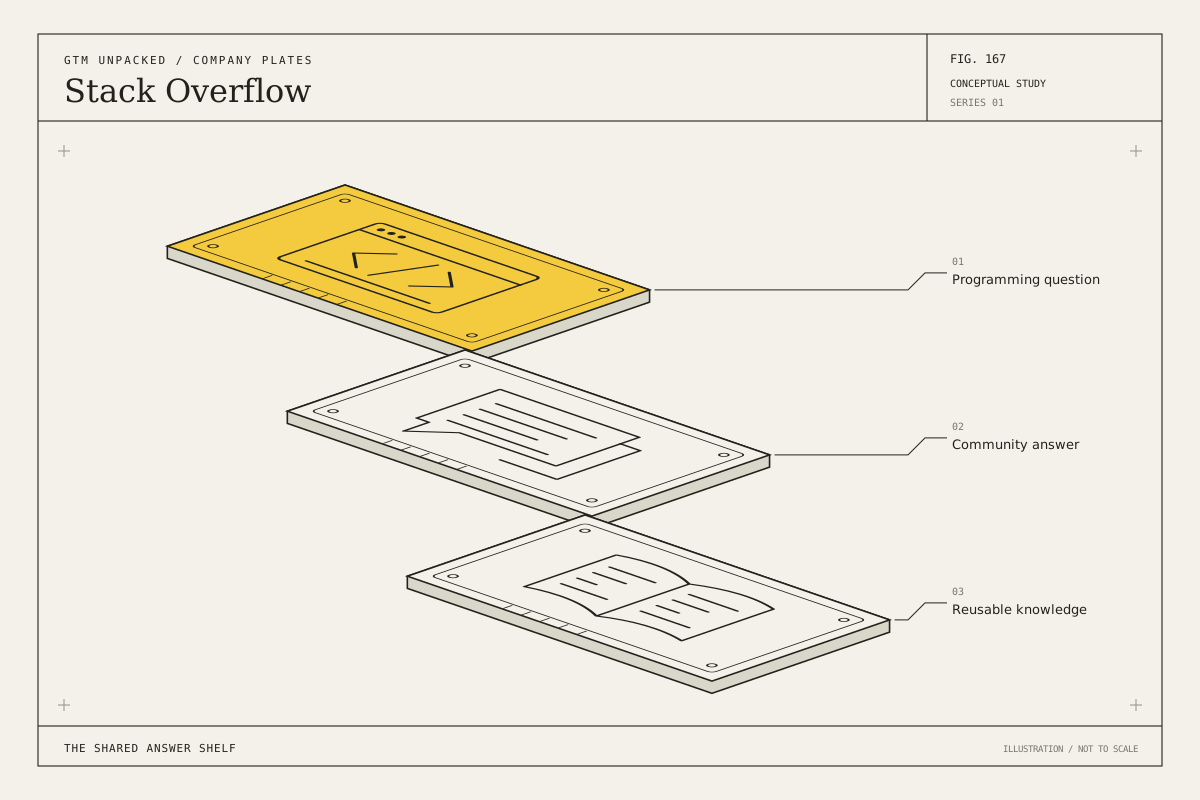
Conceptual illustration for Stack Overflow: code brackets, message bubbles, and an open book evoke programming knowledge assembled through questions and discussion, without representing verified technical architecture.
- Company
- Stack Overflow · Developer knowledge and communities · stackoverflow.com
- Conversion motions
- [Inference] This research classifies Stack Overflow as Product Led, Marketing Led, Human Led and Partner Led.
- Stack Overflow beachhead
- Programmers seeking accessible, reusable answers to coding questions. [1]
- Stack Overflow target customer
- Public developer community, advertisers, enterprise knowledge teams and data-license partners. [3][4]
- Product complexity
- [Inference] Reading an answer is simple; operating a trusted knowledge community or enterprise knowledge system is complex.
- Decision-making unit
- [Inference] Public users decide individually; advertisers and enterprise buyers have separate commercial decision processes.
- Market at entry
- Programming forums existed, but the founders objected to inaccessible answers and poor incentives. [1]
- Market today
- The current business includes advertising, enterprise knowledge and data licensing in an AI-influenced market. [3][4]
- Evidence
- Source-backed brief · 5 linked sources · research date · method and limitations
The ten-step Revenue Engine reading map
These links locate relevant evidence. A linked section does not imply every detail of the step is publicly established.
- Acquire Your First Customers: Founder Led Sales Read first customers
- Embrace GTM Experimentation Not established in this entry
- Understand Your GTM Motion Options Read GTM motion
- Pick Your GTM Motion Not established in this entry
- Generate a Lead Read GTM motion
- Turn Leads into Paying Customers Read GTM motion · Read people & process
- Retain and Grow Your Customers Read retain & expand
- Build Your GTM Team Read people & process
- Plan Your Tech Stack Read people & process
- Optimize and Scale Through Metrics Read pricing & economics
Stack Overflow origin and first customers: The founders brought an audience and an explicit business hypothesis
Joel Spolsky’s retrospective describes pairing a free programming Q&A site with paid job listings. He and developer-blogger Jeff Atwood began work in 2008; Geoff Dalgas and Jarrod Dixon joined development, and the site launched publicly in September. The idea was to make answers accessible while funding the service through a different buyer. [1]
The founding-team oral history explains that their weekly planning calls became a public podcast. This created an unusually visible record of product formation and invited a developer audience into the process. The first paying recruiter or advertiser is not identified in these accounts. [2]
[1] [2]Stack Overflow GTM motion: Community adoption and commercial conversion were separate
[Inference] The initial cold start was easier because Atwood and Spolsky already had trusted public voices. That distribution advantage cannot be reproduced merely by copying a Q&A interface. Useful answers and participation then supplied the reason to return. Charging a commercial buyer while keeping the public job free protected accessibility, but required managing two sets of interests. [1][2]
The current business surface separates Stack Ads, Stack Data Licensing and Stack Internal, formerly Teams. These are different GTM motions: audience access for advertisers, contractual access for data partners and organizational knowledge deployment for enterprise customers. A public user should not be counted as a paying customer of any of them. [3]
[3]Stack Overflow people and process: A later revenue hire matched the changed offer
The October 2024 CEO update names Jeff Bailey as newly appointed CRO, citing more than 30 years across SaaS and APIs and a focus on data licensing and enterprise knowledge products. It also describes Google Cloud and OpenAI partnerships. These dated facts explain the capability the company sought; they do not establish Bailey’s individual sales results or present tenure. [4]
[Inference] The founding team’s audience and product skills were well suited to community formation. The later commercial model demanded enterprise contracting and partnership skills as well. Treating all these activities as a single marketing-led motion would conceal meaningful differences in buyer, sales cycle and delivery responsibility. [2][4]
[2] [4]Stack Overflow retention and expansion: Enterprise knowledge needs an operating owner
Observed November 2026, Stack Internal offers a free Starter workspace and a custom Organization plan with dedicated enterprise account management. The page lists connectors, permissions, knowledge-health features and credit allowances. These are current terms; older Teams seat prices are not presented as current. [3]
[Inference] Expansion depends on whether employees contribute and retrieve trusted knowledge, not only on provisioning access. Account management must help establish ownership, review and integration into work. Public-community moderation and enterprise customer success solve related quality problems but are not interchangeable teams. Named early enterprise CSMs remain unverified. [3]
[3]Stack Overflow pricing and economics: The AI transition creates an incentive question
The 2024 OpenAI partnership announcement described OverflowAPI access and attribution commitments, alongside collaboration on Stack Overflow’s AI products. No contract price was disclosed in the inspected announcement. The present enterprise page likewise uses custom pricing beyond Starter. [3][5]
[Inference] Licensing can monetize knowledge outside the original website, but the business still depends on maintaining the community that creates and updates it. The strategic risk is optimizing commercial distribution while weakening contributor motivation or direct engagement. That is an incentive critique, not a quantified claim that the partnership caused a traffic decline. [4][5]
[Inference] Better evaluation would connect commercial revenue with contributor retention, knowledge freshness and visible attribution. The repeatable lesson is to identify the payer separately from the user, then make the relationship between them sustainable. No CAC or margin model is verified here. [1][5]
[1] [3] [4] [5]Stack Overflow economics at a glance: Pricing is only half the story.
Free public participation; separate advertising, data-license and enterprise knowledge offers. Current Stack Internal Starter is free and Organization is custom. [3][5]
See the dated pricing analysis.
[Inference] The relevant costs and conversion frictions are discussed in the analysis; no invented margin model is supplied.
Not verified in this brief.
No cohort retention figure verified in this brief.
The people in the Stack Overflow GTM story: People & capabilities.
Joel Spolsky
CofounderSoftware entrepreneur and author of Joel on Software.
Proposed the commercial connection between free Q&A and job listings. [1]
[1]Jeff Atwood
CofounderDeveloper and Coding Horror blogger.
Led early development and public product conversation. [1][2]
[1] [2]Geoff Dalgas and Jarrod Dixon
Founding developersDevelopers in the original product team.
Built the initial service with Atwood. [1][2]
[1] [2]Jeff Bailey
CRO appointed in 2024More than 30 years of SaaS and API experience, according to the announcement.
Hired to expand data-licensing and enterprise revenue. [4]
[4]Stack Overflow GTM: critical reading and analysis: Why it worked.
Where it breaks.
What worked—and why
[Inference] Existing developer trust supported community formation.
What did not work
No specific failed early sales experiment was verified; the later business faces a changed information-distribution market. [4]
What could have been better
[Inference] Evaluate commercial growth alongside contributor health and knowledge freshness.
What another founder can use
[Inference] An existing developer audience solved the community cold start; commercial buyers came through different products.
Stack Overflow go-to-market FAQ: The questions that matter.
How did Stack Overflow find its GTM motion?
An existing developer audience solved the community cold start; commercial buyers came through different products. See the sourced account and explicitly labeled analysis above.
Stack Overflow sources and open questions: Follow the sources.
- The Stack Overflow Age Joel Spolsky · primary · 2018-04-06
Inspected for the facts attributed in this brief; current pages observed November 10, 2026.
- Founding-Team Oral History Stack Overflow · interview · 2021-12-14
Inspected for the facts attributed in this brief; current pages observed November 10, 2026.
- Stack Internal Pricing Stack Overflow · primary
Inspected for the facts attributed in this brief; current pages observed November 10, 2026.
- CEO Update: Trust in AI Stack Overflow · primary · 2024-10-22
Inspected for the facts attributed in this brief; current pages observed November 10, 2026.
- OpenAI Partnership Stack Overflow · primary · 2024-05-06
Inspected for the facts attributed in this brief; current pages observed November 10, 2026.
What remains unverified
First paid account and its original contract were not verified.
Named early sales and customer-success hires, training, compensation and individual account assignments remain incompletely documented.
No verified CAC, payback, funnel conversion or numerical retention series in this brief.
Historical website/pricing screenshots were not captured for this company; dated textual evidence is distinguished from current pages.
No verified visual capture is attached to this entry. A current screenshot is not a substitute for a historical capture.