
Source numbers link to evidence. [Inference] marks analytical judgment, including motion classifications and causal explanations. Public evidence does not establish every internal decision or metric.
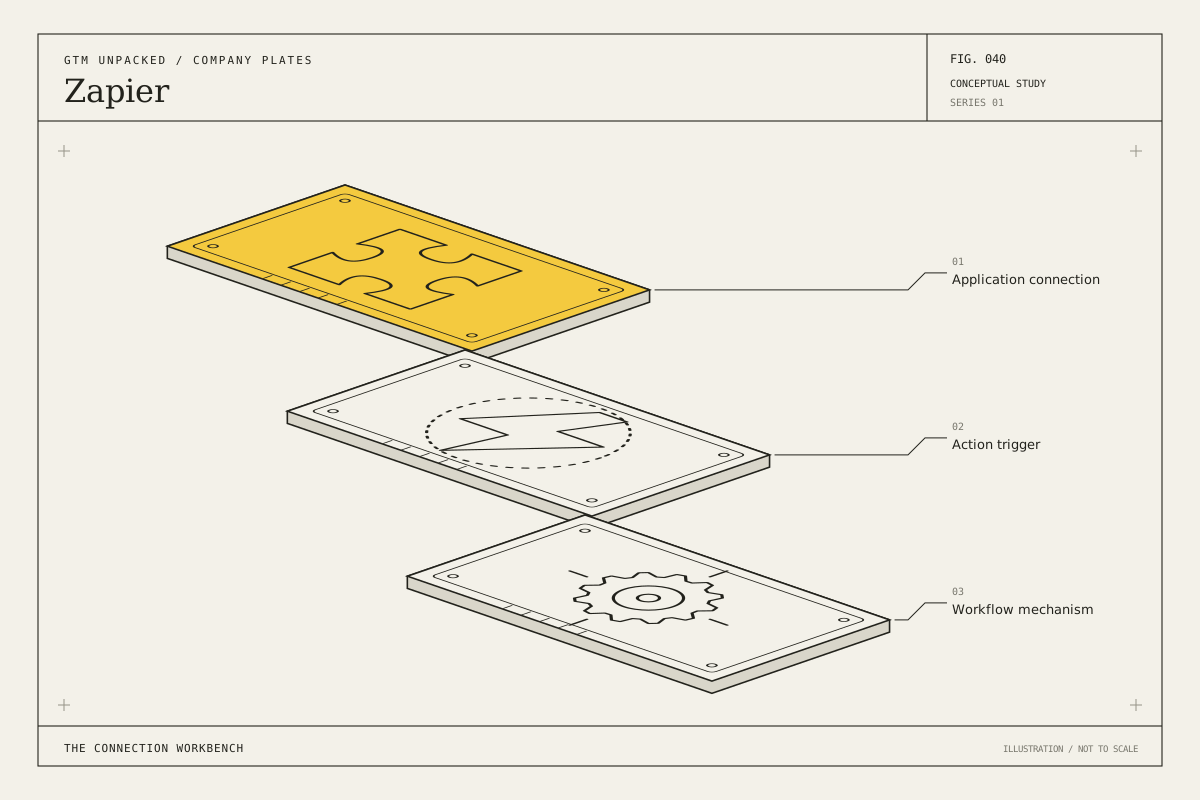
Conceptual illustration for Zapier: a puzzle piece, lightning bolt, and gear form a connection workbench, giving software coordination a simple mechanical vocabulary.
- Company
- Zapier · Workflow automation · zapier.com
- Conversion motions
- [Inference] This research classifies Zapier as Product Led and Human Led.
- Zapier beachhead
- People connecting specific web applications without building their own integrations. [1][2]
- Zapier target customer
- Individuals and teams automating work across applications, with enterprise administration and purchasing. [3]
- Product complexity
- [Inference] A two-step automation is approachable; credentials, data models and failure handling can be technically complex.
- Decision-making unit
- [Inference] Individual workflows have a simple buyer; shared business-critical automation adds security, continuity and budget owners.
- Market at entry
- The founders started a web-application integration side project in 2011. [2]
- Market today
- The current product includes shared task allowances, team administration and AI-related automation features. [3]
- Evidence
- Source-backed brief · 3 linked sources · research date · method and limitations
The ten-step Revenue Engine reading map
These links locate relevant evidence. A linked section does not imply every detail of the step is publicly established.
- Acquire Your First Customers: Founder Led Sales Read first customers
- Embrace GTM Experimentation Read experiments & lessons
- Understand Your GTM Motion Options Read GTM motion
- Pick Your GTM Motion Read beachhead & buyer · Read product & market
- Generate a Lead Read GTM motion · Read experiments & lessons
- Turn Leads into Paying Customers Read GTM motion · Read people & process
- Retain and Grow Your Customers Read retain & expand
- Build Your GTM Team Read people & process
- Plan Your Tech Stack Read experiments & lessons · Read people & process · Read product & pricing archive
- Optimize and Scale Through Metrics Read pricing & economics
Zapier origin and first customers: Andrew Warner’s first payment
Foster identifies Andrew Warner as Zapier’s first paying user: $100 via PayPal on December 2, 2011. The process included a forum connection, email follow-up, a Wufoo-to-AWeber workflow, added filtering and a Skype walkthrough. Foster explicitly describes the effort as economically unscalable at that price. [1]
[Inference] The purchase demonstrated a concrete integration problem and willingness to pay. Its strategic value was learning; treating the founder’s hours as a repeatable acquisition model would misread the evidence.
[1]Zapier beachhead and buyer: Sell the connection, not a general platform
[Inference] A buyer with two named applications and an unwanted manual handoff has an observable success criterion. That narrows the initial sales conversation. The harder platform problem is supporting many such combinations reliably without rebuilding each customer’s workflow by hand.
Zapier GTM motion: Self-service grew alongside deeper team needs
Foster’s 2017 interview dates the project to 2011 and Y Combinator participation to 2012. He describes requests about continuity when an employee leaves, which helped motivate Zapier for Teams. [2]
[Inference] Team selling can arise from individual adoption when the organization needs ownership and control. The upgrade trigger is operational dependency rather than a claim that every individual user becomes a qualified enterprise lead.
[2]Zapier product and market: Ease of entry does not erase integration complexity
[Inference] Workflow builders must reconcile authentication, field formats, permissions and changing external applications. The product can hide much of that complexity, but failures become a support and trust problem. The reviewed sources do not establish a named first enterprise buyer.
Zapier people and process: Support learned the underlying systems
Foster describes support training in API calls and underlying data models rather than memorizing every interface. Support requests and feature demand were recorded with user context, and product managers also worked in support. [2]
[Inference] This training matters because diagnostic reasoning generalizes across integrations. It can make support both a retention function and a source of product priorities, without requiring a specialist for every app pair.
[2]Zapier retention and expansion: Continuity became part of expansion
The current offer separates individual, team and enterprise needs, including shared usage and sales contact. [3]
[Inference] A customer who depends on automations has reason to centralize administration. Success work should therefore address ownership, monitoring and recovery alongside onboarding. Named account-management teams and measured renewal effects are not established here.
[3]Zapier pricing and economics: A successful action is an economic unit
The current free allowance is 100 tasks monthly, with paid Professional, Team and Enterprise offerings. Task allowances connect usage to the bill. [3]
[Inference] More automations or more frequent execution can expand revenue without proportional seat growth, but the model requires customers to understand task consumption. Revenue per task alone would not reveal gross margin because infrastructure and support costs vary.
[3]Zapier experiments and lessons: The first sale should not become the permanent process
[Inference] The first-customer story argues for manually resolving friction while the product is young. A later team should convert recurring friction into product and documentation improvements, otherwise cheap accounts can accumulate expensive service obligations. No quantified failed later acquisition program is established.
Zapier website and pricing history: Three different stages are documented
The 2011 first payment, 2017 team/support account and current task-based offer provide a partial motion history. [1][2][3] Archived pricing screenshots and detailed sales hiring remain incomplete.
[1] [2] [3]Zapier economics at a glance: Pricing is only half the story.
Free 100-task allowance and paid individual/team/enterprise tiers. [3]
Task-based subscription expansion with organizational upgrades. [3]
[Inference] Manual founder enablement was expensive relative to the first $100 sale; later economics depend on reusable product and support.
Not established by the sources reviewed.
Not established by the sources reviewed.
The people in the Zapier GTM story: People & capabilities.
Bryan Helmig
Co-founderNamed among the original side-project founders. [2]
Detailed individual commercial contribution is not established in the reviewed account. [2]
[2]Mike Knoop
Co-founderNamed among the original side-project founders. [2]
Detailed individual commercial contribution is not established in the reviewed account. [2]
[2]Zapier GTM: critical reading and analysis: Why it worked.
Where it breaks.
What worked—and why
[Inference] The founder solved a specific workflow and used the engagement to learn why the customer struggled.
What did not work
The first sale was explicitly unscalable at its price; no quantified later failed channel is established. [1]
What could have been better
[Inference] Track repeated support friction and convert it into product improvements before scaling low-value accounts.
What another founder can use
[Inference] An early sale can validate pain while still failing a repeatable acquisition-cost test.
Zapier go-to-market FAQ: The questions that matter.
How did Zapier get its first customers?
Foster identifies Andrew Warner as Zapier’s first paying user: $100 via PayPal on December 2, 2011. The process included a forum connection, email follow-up, a Wufoo-to-AWeber workflow, added filtering and a Skype walkthrough. Foster explicitly describes the effort as economically unscalable at that price. [1]
Which go-to-market motions is Zapier classified under?
[Inference] This research classifies Zapier as Product Led and Human Led. Motion labels describe routes across segments and periods, not measured revenue shares.
Zapier sources and open questions: Follow the sources.
- How Andrew Warner became our first paying user Wade Foster / Zapier · primary
Named first payer, payment, follow-up and walkthrough.
- Wade Foster on scaling Zapier Intercom · interview · 2017-11-09
Founder interview on origins, support training and team needs.
- Zapier pricing Zapier · primary
Task allowances and individual/team/enterprise packaging.
What remains unverified
Detailed founder training, early seller biographies and enterprise customer sequence not established.
CAC, retention cohorts, historical screenshots and full technology stack remain incomplete.
No verified visual capture is attached to this entry. A current screenshot is not a substitute for a historical capture.