

Each fact links to a numbered source at the foot of the page, checked on 18 Nov 2026. Headcount, leadership and prices change, so each carries its own date. Figures a company reports about itself are attributed to it. Read the research method.
Surge AI at a glance
- Company
- Surge AI · AI training data · surgehq.ai
- Legal name
- Surge Labs, Inc.[3]
- Founders
- Edwin Chen[2]
- Headquarters
- San Francisco, California[2]
- Employees
- 110 (as of 2025)[2]
- Ownership
- Private company[2] Wikipedia reports that in September 2025 Edwin Chen was CEO and majority owner with a 75% stake.
- Leadership
- Edwin Chen (CEO) (as of November 2026)[2]
- Industry
- AI training data
- Checked
- 6 sources · facts checked · figures that change carry their own date
What does Surge AI do?
Surge AI sells data that people create to train and evaluate AI models. Its products page lists reinforcement learning (RL) environments and agents, rubrics and verifiers, reinforcement learning from human feedback (RLHF), supervised fine-tuning (SFT), human evaluation, expert professional domains, multilingual work, multimodal data and off-the-shelf datasets. [1]
The company says it recruits experts in each field, such as doctors, lawyers, investment bankers and mathematicians, to shape models through their judgment. It says it operates in over 70 languages. [1]
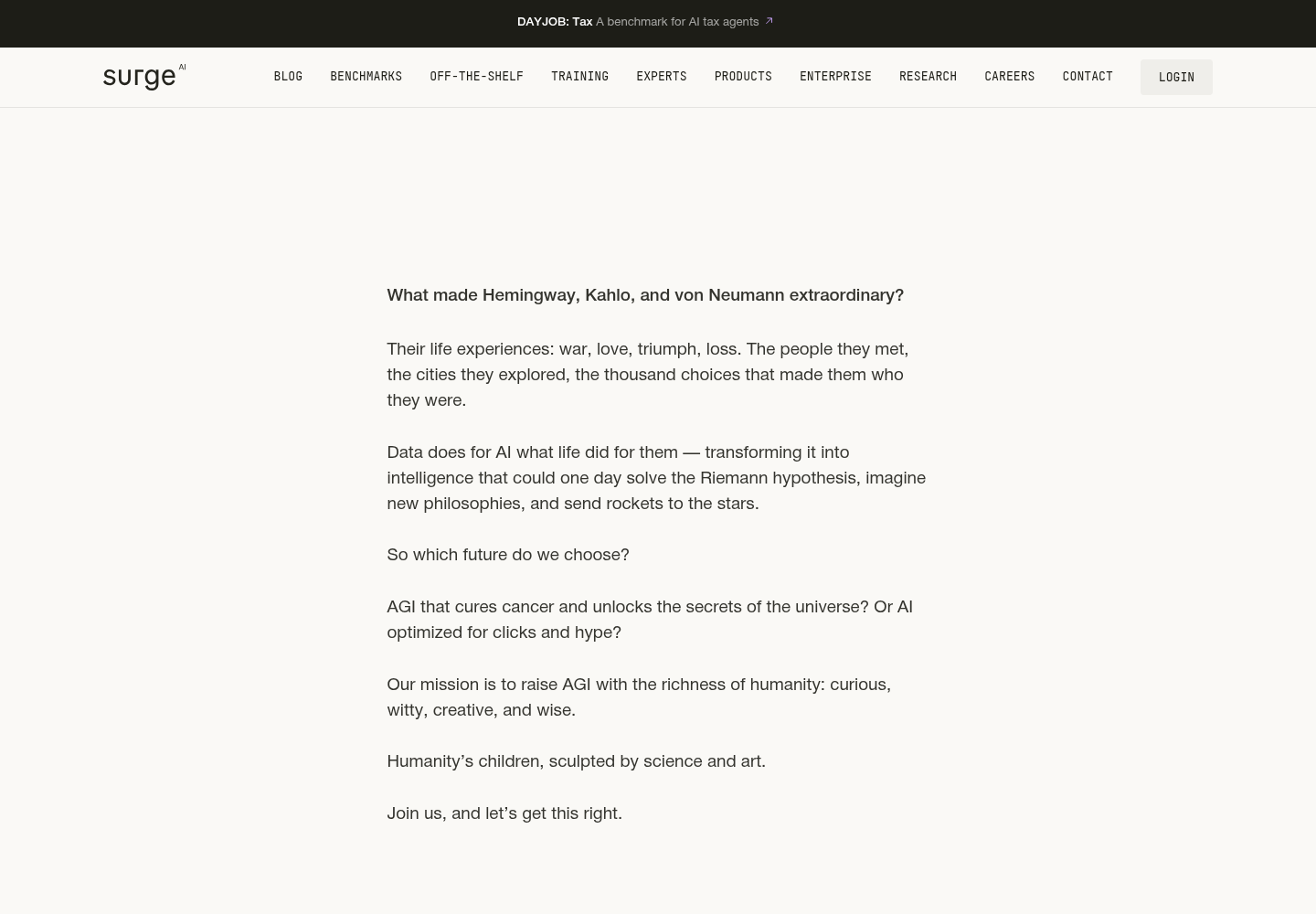
On its home page Surge states its mission as raising AGI with the richness of humanity. It also publishes benchmarks, including DAYJOB tests for fields such as law, tax, healthcare and finance. [4]
Surge AI products
- RL Environments and Agents
- Reinforcement learning environments that challenge agentic models, with verifiers designed to reward their behavior. [1]
- Rubrics and Verifiers
- Scoring systems designed to grade model outputs. [1]
- RLHF
- Human preference data used to train models from feedback. [1]
- SFT
- Demonstration data used to build a model’s foundational skills before preference or reward training. [1]
- Human Evaluation
- Human judgment of whether a model’s answers make sense, are useful and are safe. [1]
- Off-The-Shelf Data
- Pre-built datasets of expert reasoning covering RL environments, coding and core model capabilities. [1]
Who uses Surge AI?
Surge’s buyers are teams that build AI models. Chen’s December 2021 launch essay named OpenAI, Airbnb and Amazon as users at launch. [5]
Wikipedia lists Anthropic, OpenAI, Google, Microsoft, Meta and the U.S. Army as customers. The company does not publish a customer list on its products page. [1][2]
How does Surge AI make money?
Surge sells data and services through negotiated contracts. Its published terms for enterprise pilots describe a paid pilot in which Surge creates and delivers a dataset under an order form; the customer can evaluate it for 90 days before deciding on a broader commercial agreement. [3]
Forbes reported approximately $1.2 billion of revenue for 2024, which Wikipedia also lists. The company has not published audited figures. [2][6]
How much does Surge AI cost?
As of November 2026 Surge does not publish a price list. Prices are set in order forms for each customer. Its terms for paid enterprise pilots say that Surge invoices the fees on delivery of the pilot dataset and that each invoice is due within 30 days. [3]
Prices are a dated observation: what Surge AI listed on . They change; check the company’s own page before relying on them. [3]
Surge AI history
Wikipedia says Edwin Chen founded Surge AI in 2020, motivated by dissatisfaction with the quality of crowdsourced data labeling. Chen published an essay introducing the platform in December 2021. [2][5]
Wikipedia reports that as of June 2025 Surge had been bootstrapped by Chen with no external funding, and that in July 2025 it was in talks with investors including Andreessen Horowitz, Warburg Pincus and TPG. It also reports that in May 2025 a class action lawsuit alleged the company misclassified its data annotators as independent contractors. [2]
Surge AI timeline
How did Surge AI grow?
Sell researchers better judgment, then deliver it at industrial scale.
Surge’s original wedge was high-quality NLP labeling. Edwin Chen used his technical reputation and writing to reach researchers, then built a premium service around human judgment, tooling and close research collaboration. The model evolved toward expert data, evaluations and reinforcement-learning work. Its growth does not establish universal customer loyalty: Forbes reported departures by OpenAI and Cohere. The company’s privately negotiated contracts and scarce public funnel metrics limit precise unit-economic analysis.
This research classifies Surge AI as Human Led. Motion labels describe routes across segments and periods, not measured revenue shares. Acquisition channels and operating patterns are shown separately in the case.
This part restates the GTM Unpacked research case on Surge AI (deep research, research date ). Its evidence and source numbers are in the case.
Read the Surge AI GTM case How did Surge AI grow? Selling judgment through research
Surge AI website snapshots
Captures collected for the research case. Each caption carries its own date and source. Explore the visual archive
Surge AI: frequently asked questions
What is Surge AI?
Surge AI is an American data company that supplies human-generated data, such as expert feedback and evaluations, for training and testing AI models. Wikipedia lists it as founded in 2020 by Edwin Chen and based in San Francisco; its legal name is Surge Labs, Inc. [1][2][3]
Who founded Surge AI?
Surge AI was founded by Edwin Chen. [2]
Where is Surge AI headquartered?
Surge AI is headquartered in San Francisco, California. [2]
How many employees does Surge AI have?
Surge AI had 110 employees as of 2025. [2]
How much does Surge AI cost?
Surge AI does not publish prices. Customers buy through order forms, and enterprise pilots are paid, with a 90 day evaluation period. [3]
Who owns Surge AI?
Surge AI is privately held. Wikipedia reports that Edwin Chen was CEO and majority owner with a 75% stake in September 2025. [2]
What is Surge AI used for?
AI developers use it to get human feedback data, expert-written demonstrations, evaluations and RL environments for training models. [1]
Sources
Every source was read on 18 Nov 2026. These numbers belong to this profile; the Surge AI GTM case has its own source list.
- Products Surge AI · company source
Surge AI’s own list of its data products and services.
- Surge AI Wikipedia · reference work
Founding year, founder, San Francisco base, headcount, ownership, customers, funding talks and the 2025 lawsuit.
- Enterprise Pilot Terms of Sale Surge AI · company source · published October 21, 2026
Surge’s published terms for paid enterprise pilots, including its legal name, the evaluation period and invoicing.
- Surge AI homepage Surge AI · company source
Surge AI’s own statement of its mission and a list of benchmarks it publishes.
- Surge AI: A Modern Data Labeling Platform for NLP Edwin Chen · company source · published December 29, 2021
Edwin Chen’s December 2021 essay introducing the platform, which names OpenAI, Airbnb and Amazon as users.
- How a Google alum became a low-key AI billionaire Forbes Australia · reporting · published September 17, 2025
Forbes’ report of approximately $1.2 billion of revenue in 2024.