
Source numbers link to evidence. [Inference] marks analytical judgment, including motion classifications and causal explanations. Public evidence does not establish every internal decision or metric.

Conceptual illustration arranging people markers, a grid, and code brackets as a data workbench, distinguishing human judgment, examples, and software access as metaphors.
- Company
- Scale, also listed as Scale AI · AI training data · scale.com
- Conversion motions
- [Inference] This research classifies Scale as Human Led and Partner Led.
- Scale beachhead
- Initially human tasks exposed through an API; autonomous-vehicle computer-vision data became an early specialized market. [1][12]
- Scale target customer
- AI laboratories, autonomy teams, large enterprises and governments buying data, evaluation and deployed AI applications. [4][9][10]
- Product complexity
- [Inference] Integration was deliberately simplified, while delivery required workforce coordination, quality systems and increasingly bespoke enterprise implementation. [1][9]
- Decision-making unit
- [Inference] Technical champions initiate evaluation; strategic data and government deployments add procurement, security, legal and executive approval. [4][6]
- Market at entry
- The 2016 proposition addressed tasks software could not perform reliably. The emerging ML market needed labeled data, even before generative AI became a mass-market category. [1][12]
- Market today
- The company’s 2026 message emphasizes reliable deployed AI and enterprise/public-sector use, while continuing data work. Competition and vendor neutrality affect buyer choice. [4][6][7]
- Evidence
- Deep research · 14 linked sources · research date · method and limitations
The ten-step Revenue Engine reading map
These links locate relevant evidence. A linked section does not imply every detail of the step is publicly established.
- Acquire Your First Customers: Founder Led Sales Read first customers
- Embrace GTM Experimentation Read experiments & lessons
- Understand Your GTM Motion Options Read GTM motion
- Pick Your GTM Motion Read beachhead & buyer · Read product & market
- Generate a Lead Read GTM motion · Read experiments & lessons
- Turn Leads into Paying Customers Read GTM motion · Read people & process
- Retain and Grow Your Customers Read retain & expand
- Build Your GTM Team Read people & process
- Plan Your Tech Stack Read experiments & lessons · Read people & process · Read product & pricing archive
- Optimize and Scale Through Metrics Read pricing & economics
Scale GTM timeline: From wedge to engine.
API for human work
YC publishes the contemporaneous launch interview. [1]
Customer-success lesson
Wang discusses early selling, hiring and the cost of neglecting customer experience. [2]
Hire an experienced operator
Jason Droege joins as chief strategy officer. [3]
Meta transaction and succession
Investment expands the commercial relationship; Wang moves to Meta and Droege becomes interim CEO. [5]
Expand enterprise and public-sector applications
Company reports a broader business mix and strategic partnerships. [4]
Scale origin and first customers: Acquire the first customers: make human work callable
Y Combinator’s July 2016 interview introduced Scale as an API for human labor. Alexandr Wang and Lucy Guo had seen problems involving moderation and other human tasks at companies including Quora and Snapchat. The pitch was broad: developers could send work such as extraction and categorization through a simple interface while Scale organized execution and quality control. This primary record is more precise than retroactively saying the company launched only for autonomous vehicles. [1]
In a 2019 SaaStr interview, Wang recalled initial contracts worth only a few thousand dollars and later sales hires pursuing six- and seven-figure deals. He argued for choosing early customers representative of the business you want to build. The interview does not name the first paying account or supply the original outreach and contract. [2]
[Inference] The early commercial skill was translating a messy service into a clear developer promise. A simple interface reduced adoption friction without making the underlying business simple. The founder still needed to learn which repeated customer problems justified building a specialized operation. [1]
[1] [2]Scale beachhead and buyer: Specialize where data quality is operationally important
Scale’s published chronology places computer-vision labeling for autonomous vehicles in 2016 and a sensor-fusion data engine in 2017. Its automotive offer now spans initial datasets, continuous improvement, targeted scenario collection, labeling and evaluation. This is a workflow rather than a one-time purchase of boxes drawn on images. [10][12]
[Inference] Autonomy provided a strong beachhead because the customer repeatedly generated new data and needed difficult cases resolved. That supports expansion through growing coverage and iteration. However, the published chronology does not establish the share of early revenue attributable to vehicles or the first automotive customer’s identity. [10][12]
[10] [12]Scale GTM motion: Follow increasing deal complexity
The live data-engine page combines a dashboard path and educational material with a prominent demo request. The main pricing URL redirects to a one-to-one introduction form, not a current public rate card. These observable conversion paths support a product-assisted human sales interpretation. They do not establish how many transactions close self-service. [9][11]
[Inference] A developer-friendly API can be the entry point while the economic decision remains a negotiated enterprise engagement. As tasks become proprietary and deployments affect important workflows, technical assessment, delivery planning and trust become part of conversion. Public-sector contracting adds another set of relationships and buying constraints; it should not be folded into the same sales-cycle assumption as a developer experiment. [9][11]
Scale’s January 2026 business update names Microsoft and Anduril in the Thunderforge effort, and Google Cloud, Microsoft and AWS among global partners. It reports enterprise business involving Mayo Clinic, BP and Allianz. Partner participation is documented; channel-sourced revenue and co-sell conversion are not. [4]
[4] [9] [11]Scale product and market: Expand from data supply to deployed applications
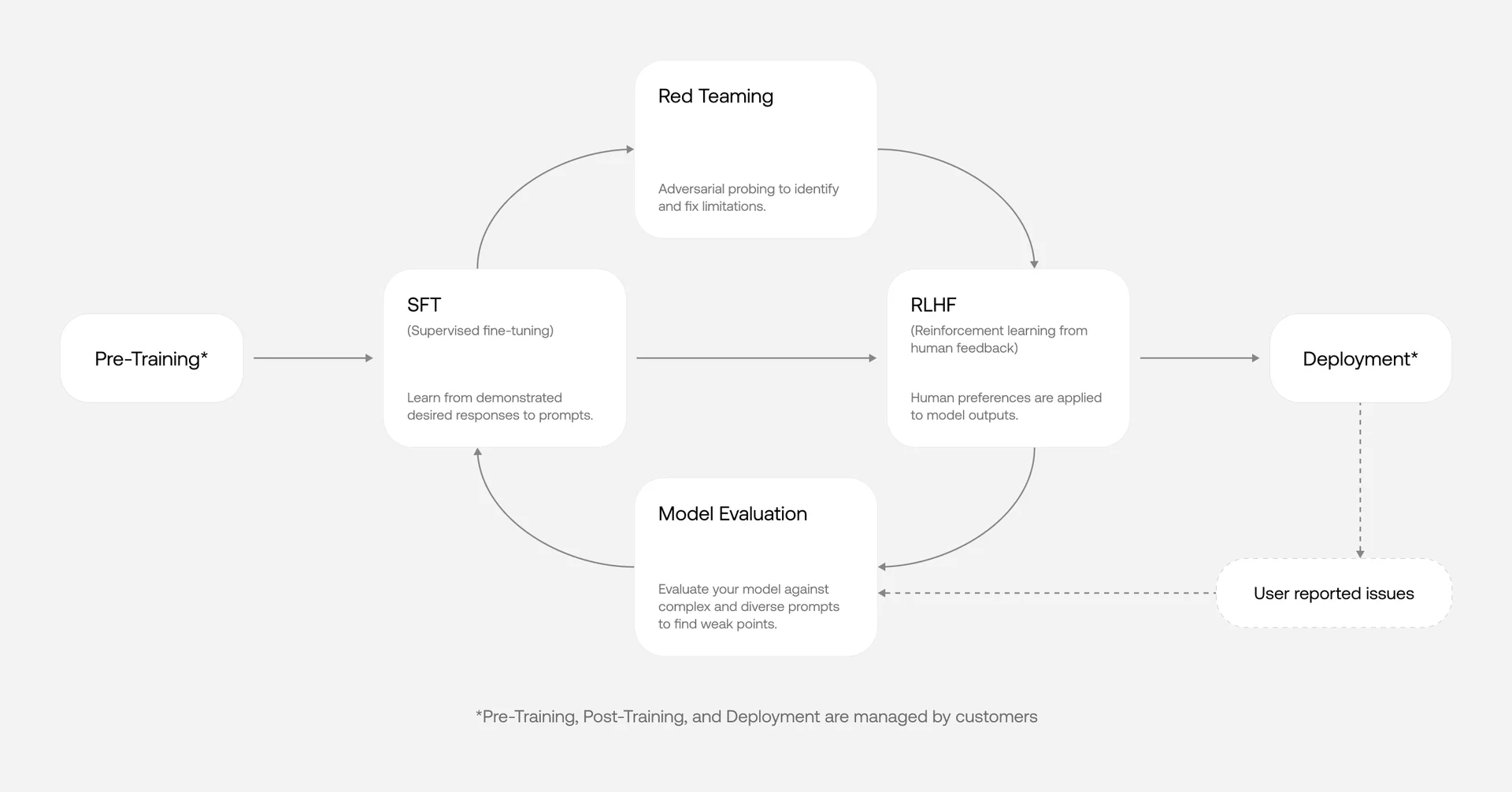
The current Data Engine advertises generation, RLHF, red teaming and evaluations across text, images, video and sensor data. The website provides guides and product demonstrations that help technical buyers understand the proposed workflow. These are enablement assets, not evidence that every advertised benefit is achieved for every customer. [9]
The 2026 business update says applications revenue doubled in the second half of 2025 versus the first, while new business exceeded $1 billion for the year. It separately reports about $200 million in public-sector contracts. New business and contract values must not be relabeled recognized revenue. [4]
[Inference] Moving into applications can capture a larger share of the customer’s problem, but also changes the delivery model. Selling useful outcomes requires implementation capability and sustained adoption, not simply producing a dataset. The opportunity to expand is coupled to a risk of service complexity and uneven project margins. [4][9]
[4] [9]Scale people and process: Build an organization that can carry difficult accounts
Wang’s SaaStr account says early customer-success recruiting favored consultants able to manage ambiguity and enterprise relationships while the product was still changing. He emphasized direct customer interaction and onboarding. This is evidence for a hiring profile, not a list of named account managers or proof that every successful hire came from consulting. [2]
Jason Droege joined as chief strategy officer in September 2024 after work at Uber Eats and Axon. His own announcement emphasized operational detail as a lesson from Uber. When Wang moved to Meta in June 2025, the board appointed Droege interim CEO; the announcement credited him with enterprise and AI-lab growth. [3][5]
[Inference] The leadership transition illustrates two distinct capabilities: creating a category through founder conviction, then coordinating delivery and restoring confidence across large customers. Neither is interchangeable with simply hiring more account executives. [3][5][7]
[2] [3] [5] [7]Scale retention and expansion: The founder’s explicit retention lesson
Wang acknowledged that Scale initially concentrated on acquisition and neglected customer success. After investing in customer experience, happier customers referred others and growth accelerated. He recommended considering a success hire after the first one or two customers, before a sales team. This is the founder’s retrospective claim, not a controlled attribution experiment. [2]
[Inference] In a data service, onboarding teaches both parties what acceptable work means. Successful expansion depends on aligning task specifications, quality feedback and delivery operations before asking for more volume. The product’s ease of submission cannot substitute for that agreement. [1][9]
After the Meta transaction, customer reassurance became account-management work. Forbes’ May 2026 reporting describes face-to-face visits and detailed explanations of deal protections led by Droege. It reports that Google initially stopped and later resumed work, while OpenAI was a prominent lost customer. These later findings update the earlier June 2025 reports of planned departures; they do not establish a complete retention rate. [7][13]
[1] [2] [7] [9] [13]Scale pricing and economics: Enterprise scale does not remove concentration risk
No current standardized price schedule was verified: the pricing route redirects to contact sales. Consequently, unofficial per-image prices should not be presented as a current quote for expert data, application deployments or government work. Contract scope and the delivered service matter. [11]
Reuters reported $870 million in 2024 revenue and approximately $150 million of Google spending that year, citing sources. Forbes later reported Scale’s claim of just under $1 billion in 2025 revenue. Those figures have different dates and evidentiary status from the unverified $2 billion figure in this project’s starting list. [7][13]
[Inference] The main cost-to-serve questions are labor quality, review and rework, project-management intensity and implementation effort. Large customer concentration can make revenue grow quickly while leaving renewal and negotiating power fragile. Public information does not support a dependable CAC, payback, gross-margin or rep-productivity model. [9][13]
[7] [9] [11] [13]Scale experiments and lessons: The Meta deal exposed the value of neutrality
The June 2025 announcement valued Scale above $29 billion and expanded its relationship with Meta while Wang moved to Meta. A subsequent post by Lauren Lennon and Alex Levinson responded directly to customer questions, stating that operations remained independent and customer confidential information would not be shared. Those are company assurances, not an independent audit of safeguards. [5][6]
[Inference] A vendor supplying competing frontier labs sells trust alongside output. A strategic investment can improve financing and anchor demand while making other customers question alignment. This is a GTM tradeoff, even if contractual controls are strong. The reputational consequence may arise before any actual disclosure of customer information. [5][6][13]
By May 2026 Droege described reorienting investment toward applications for enterprises and governments. Forbes reported that some lab relationships returned but not all. The evidence supports disruption and adaptation rather than either a simple collapse narrative or an unqualified success story. [7]
[5] [6] [7] [13]Scale website and pricing history: From API utility to institutional reliability
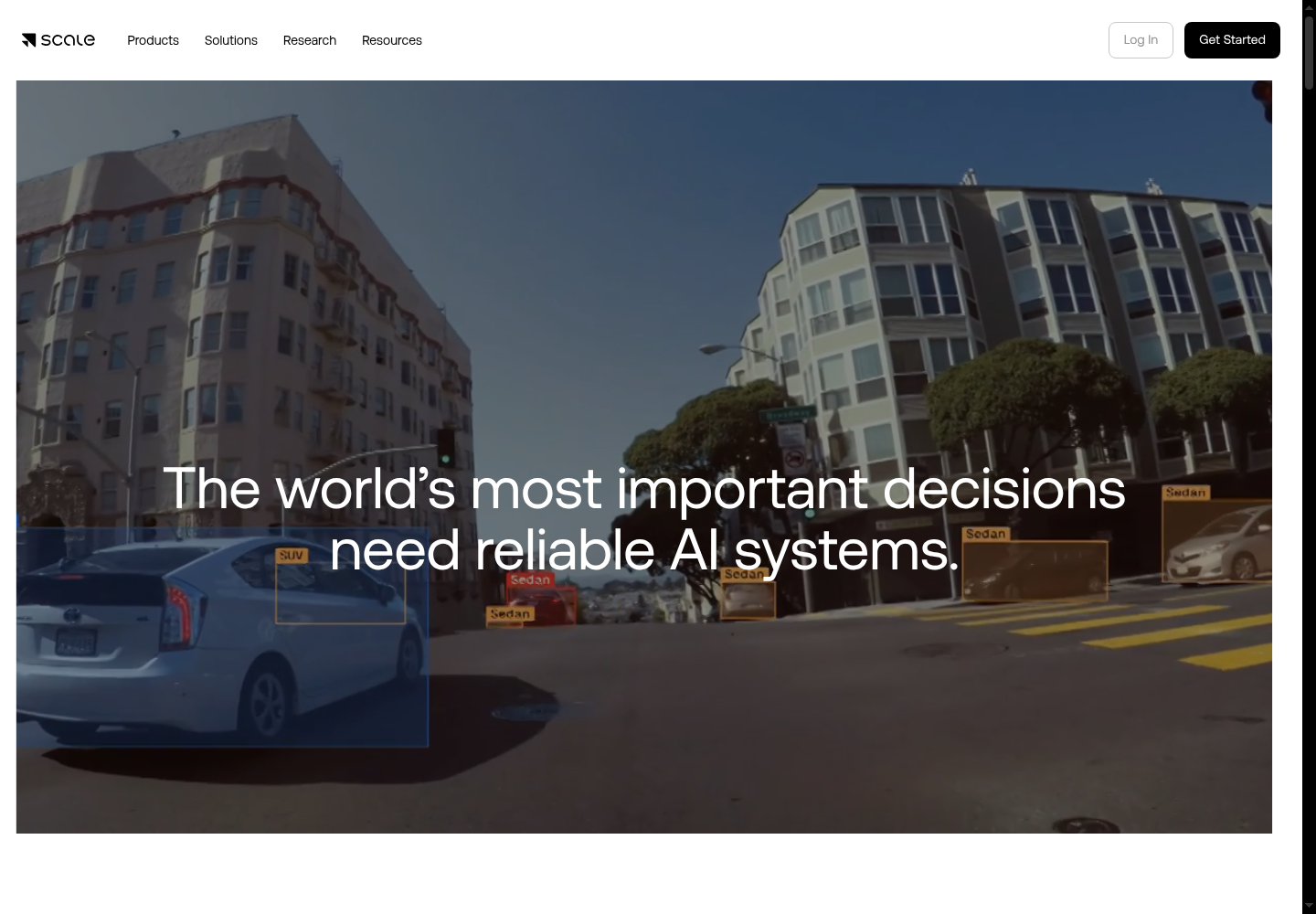
The 2016 YC page documents the original API-for-human-work message and includes a founder photograph. Current pages emphasize reliable AI systems, enterprise and government use, and conversations with the company. A live homepage screenshot was captured. Historical pricing screens were not retrieved; current page navigation cannot establish an earlier self-service price or its discontinuation date. [1][11][14]
[1] [11] [14]Scale economics at a glance: Pricing is only half the story.
Observed November 10, 2026: pricing URL redirects to a sales introduction; no verified comparable rate card. [11]
Negotiated data, deployment and enterprise/public-sector engagements.
[Inference] Labor, quality review, technical delivery and customer concentration shape contribution economics.
Not publicly verified.
The people in the Scale GTM story: People & capabilities.
Alexandr Wang
Cofounder; CEO until the June 2025 Meta moveTechnical background included Quora, Addepar and MIT machine-learning work, as described in his SaaStr interview.
Led early market development and later publicly articulated the customer-success lesson.
[2] [5]Jason Droege
Chief Strategy Officer from September 2024; interim CEO appointed June 2025Prior operating experience at Uber Eats and Axon.
Led the post-transaction business and customer reassurance; later emphasized enterprise applications.
[3] [5] [7]Lauren Lennon and Alex Levinson
Authors of the June 2025 customer-trust statementTitles and personal backgrounds were not established from the inspected statement.
Publicly communicated the company’s independence and information-access assurances.
[6]“the magic is in the details”Jason Droege, describing his lesson from Uber [3]
Scale GTM: critical reading and analysis: Why it worked.
Where it breaks.
What worked—and why
[Inference] A simple technical entry made complex human operations easier to buy. [1]
[Inference] Repeated data work created a natural expansion opportunity when delivery earned confidence. [10]
What did not work
Wang acknowledged underinvesting in customer success early. [2]
The Meta deal caused documented customer uncertainty and account disruption. [6][7][13]
What could have been better
[Inference] Treat neutrality and governance as commercial product requirements before strategic transactions, with explicit account-risk scenarios.
[Inference] Separate implementation contribution and renewal metrics from headline contract growth.
What another founder can use
[Inference] A service hidden behind an API still needs customer-success investment early.
[Inference] Partnerships can create distribution and simultaneously make the vendor less attractive to a partner’s competitors.
Scale website and pricing captures: Product, positioning & pricing.
Captures and image sources are dated individually. Historical gaps are kept explicit. Explore the visual archive
Scale go-to-market FAQ: The questions that matter.
Was Scale product led from the beginning?
The original product exposed human work through an API, but the later documented commercial model includes negotiated enterprise selling. A simple interface does not establish a wholly self-service business. [1][11]
What did Scale learn about customer success?
Wang acknowledged an early acquisition bias and recommended investing in success very early. [2]
Scale sources and open questions: Follow the sources.
- Scale: An API for Human Labor Y Combinator · interview · 2016-07-26
Contemporaneous founder launch, problem and original API proposition.
- SaaStr Podcast 227: Alexandr Wang SaaStr · interview · 2019-04-24
Publication metadata verified. Early deal sizes, hiring and customer-success mistake.
- Why I Joined Scale: Jason Droege Scale AI · primary · 2024-09-23
Operating background and hiring rationale.
- Scale’s Next Era: Building for 2026 Scale AI · primary · 2026-01-22
Company-reported business mix, partners and customers.
- Scale AI Announces Next Phase of Company’s Evolution Scale AI · primary · 2025-06-12
Meta investment and leadership succession.
- What Meta’s Investment Means for Our Customers, Partners, and Contributors Scale AI · primary · 2025-06-18
Company response to independence and confidentiality concerns.
- Inside Scale AI’s business after Meta’s bombshell $14 billion deal Forbes Australia · reporting · 2026-05-19
Later customer returns/losses, revenue reporting and strategy adaptation.
- Lucy Guo Y Combinator · primary
Professional background and founder identification.
- Scale Data Engine Scale AI · primary
Current product, enablement and conversion surfaces.
- Automotive Data Engine Scale AI · primary
Repeated data-development workflow.
- Meet with our team Scale AI · primary
Destination of pricing redirect observed November 10, 2026.
- Scale’s Legacy of AI Innovation Scale AI · primary
Company chronology of early vehicle labeling and sensor fusion.
- Google, Scale AI’s largest customer, plans split after Meta deal Reuters via WHTC · reporting · 2025-06-13
Contemporaneous reported customer plans and 2024 revenue; later developments treated separately.
- Scale AI homepage Scale AI · primary
Live positioning and screenshot.
What remains unverified
The first paying account and its original founder sales process are not verified.
No named early customer-success or account-management hire was established.
CRM, marketing automation and internal sales methodology were not verified.
The unverified $2B figure in this project’s starting list is not established here as recognized annual revenue or ARR.
No validated historical pricing screenshots, CAC, payback, numerical NRR or segment margins.