
Source numbers link to evidence. [Inference] marks analytical judgment, including motion classifications and causal explanations. Public evidence does not establish every internal decision or metric.
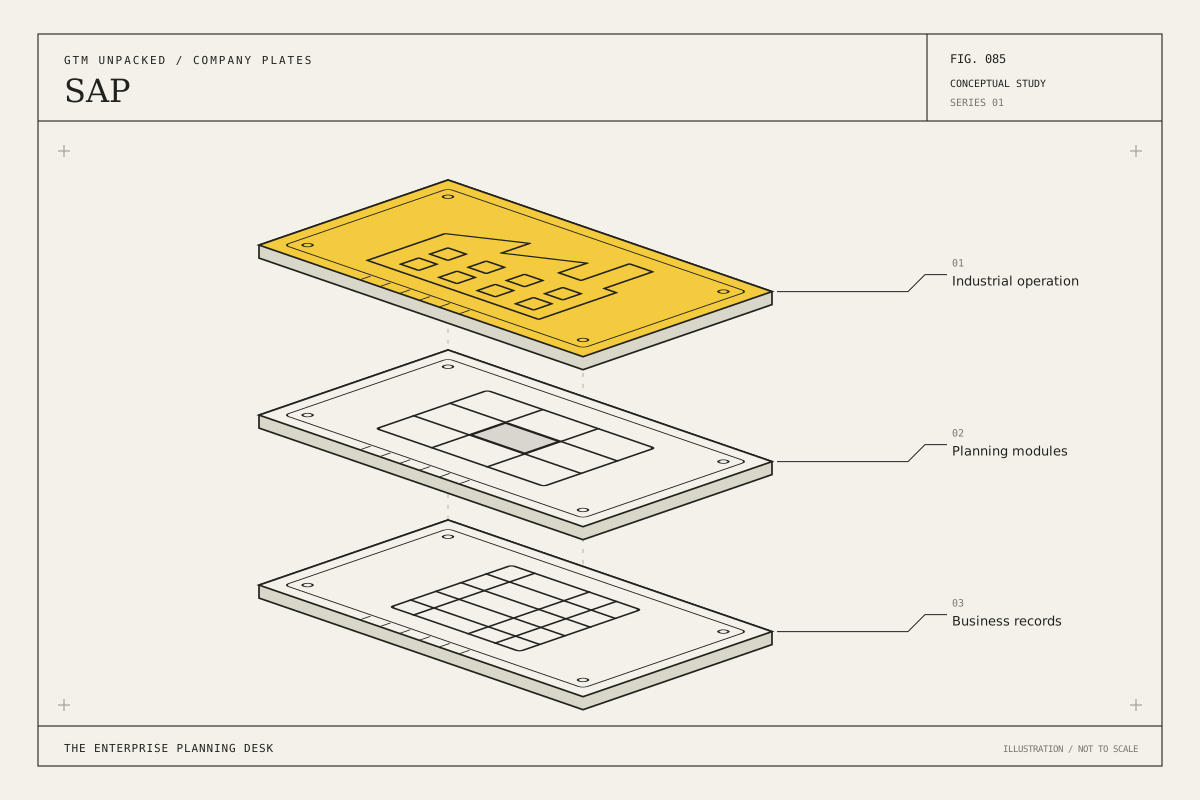
Conceptual illustration for SAP: a factory, modular grid, and ledger compose an enterprise planning desk, bringing operations and business records into one view.
- Company
- SAP · Enterprise resource planning · sap.com
- Conversion motions
- [Inference] This research classifies SAP as Human Led.
- SAP beachhead
- ICI's German operations and nearby industrial businesses.
- SAP target customer
- Companies wanting integrated, real-time business information and transaction processing.
- Product complexity
- [Inference] Integrated accounting and materials workflows span departments and rely on accurate shared data.
- Decision-making unit
- [Inference] Finance, operations, IT and executive sponsors can participate in a significant process change.
- Market at entry
- Category awareness and competing alternatives at initial launch require further historical research.
- Market today
- The historical source is not evidence of the current competitive position; present-day market maturity remains to be assessed.
- Evidence
- Source-backed brief · 1 linked source · research date · method and limitations
The ten-step Revenue Engine reading map
These links locate relevant evidence. A linked section does not imply every detail of the step is publicly established.
- Acquire Your First Customers: Founder Led Sales Read first customers
- Embrace GTM Experimentation Not established in this entry
- Understand Your GTM Motion Options Read GTM motion
- Pick Your GTM Motion Not established in this entry
- Generate a Lead Read GTM motion
- Turn Leads into Paying Customers Read GTM motion
- Retain and Grow Your Customers Read retain & expand
- Build Your GTM Team Not established in this entry
- Plan Your Tech Stack Not established in this entry
- Optimize and Scale Through Metrics Read pricing & economics
SAP: The evidence: origins and growth
SAP's official early history says five former IBM employees founded the company in 1972 and spent much of their time at first customer ICI's German data center. Development and testing often ran on customer mainframes at night or on weekends. Financial accounting became an initial module, followed by purchasing and materials management. Later modules were commissioned by specific customers. SAP began organized customer training events in 1977. This history documents intimate customer development; it does not by itself establish the later global systems-integrator sales model. [1]
[1]SAP: Revenue Engine interpretation
[Inference] Deep customer proximity can reveal where integration creates value. The scaling challenge is separating repeatable needs from customer-specific customization. [1]
[1]SAP: Enablement and expansion
SAP records its first customer training courses and customer-assisted application demonstrations in 1977. These provided a documented early enablement mechanism. [1]
[1]SAP: Pricing and economic constraints
[Inference] Customer-funded development can expose useful requirements, but a product business needs reusable modules instead of maintaining a different system for each client. Actual CAC, gross margin, payback, and cohort retention were not established by this research pass.
SAP economics at a glance: Pricing is only half the story.
Historical and current price cards have not been verified.
Not established by the source reviewed
[Inference] Customer-funded development can expose useful requirements, but a product business needs reusable modules instead of maintaining a different system for each client.
Not established by the source reviewed
Not established by the source reviewed
The people in the SAP GTM story: People & capabilities.
Dietmar Hopp
CofounderFormer IBM employee, as were the five founders.
Part of the team developing software alongside early customers.
[1]Hasso Plattner
CofounderFormer IBM employee.
Part of the founding team pursuing integrated real-time software.
[1]SAP GTM: critical reading and analysis: Why it worked.
Where it breaks.
What worked—and why
[Inference] Deep customer proximity can reveal where integration creates value. The scaling challenge is separating repeatable needs from customer-specific customization. [1]
What did not work
This brief does not establish a documented failed GTM experiment; absence of evidence is not evidence of flawless execution.
What could have been better
[Inference] Validate the conversion and retention of the beachhead cohort before treating reach or cumulative user counts as proof of a repeatable revenue engine.
What another founder can use
[Inference] Deep customer proximity can reveal where integration creates value. The scaling challenge is separating repeatable needs from customer-specific customization.
SAP go-to-market FAQ: The questions that matter.
What is the documented GTM lesson from SAP?
[Inference] Deep customer proximity can reveal where integration creates value. The scaling challenge is separating repeatable needs from customer-specific customization. [1]
Which go-to-market motions is SAP classified under?
[Inference] This research classifies SAP as Human Led. Motion labels describe routes across segments and periods, not measured revenue shares.
SAP sources and open questions: Follow the sources.
- History | 1972 - 1980 | About SAP sap.com · primary
Source inspected for the specific facts and attributed account in this brief.
What remains unverified
Research brief, not a completed company investigation.
First paying-customer identity and founder-led sales sequence are incomplete unless explicitly documented above.
Named early sales, success and account-management hires, biographies, training and internal GTM tools need further evidence.
Current pricing, cohort economics, market evolution and historical website screenshots have not all been verified.
No verified visual capture is attached to this entry. A current screenshot is not a substitute for a historical capture.